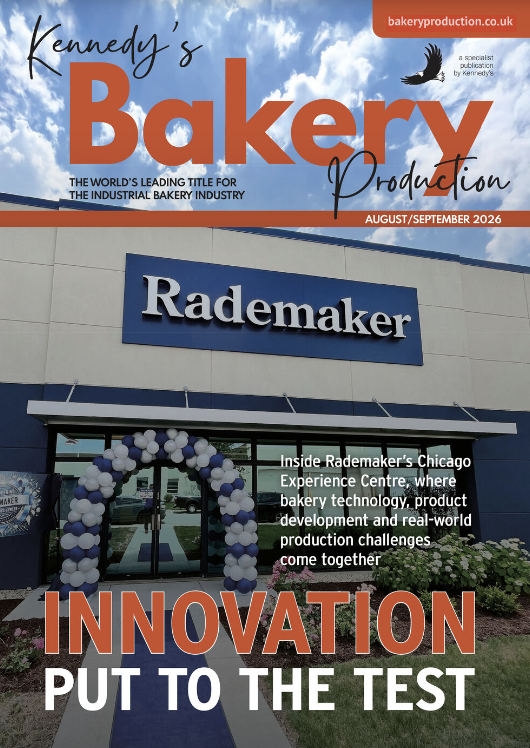
Kiran Grewal finds a company taking a measured approach to innovation, combining technical testing with a long-term view of its customers, people and industry.
There are some visits where the machinery is the story. Then there are those where the machinery becomes a means of understanding something broader: how a company thinks, how it works with its customers and, perhaps most importantly, how it sees the future of an industry.
My visit to Rademaker’s Experience Centre in Elk Grove Village, just outside Chicago, Illinois, offered something of the latter. I was invited to spend time at the facility as Editor of Kennedy’s, to see the centre in operation, meet the people behind it and gain a closer understanding of how Rademaker is approaching the complex relationship between bakery technology, product development and industrial production.
It is an interesting moment in Rademaker’s history to make that journey. The company traces its origins back to 1977, when Theo Rademaker established the business with two employees in a garage in Soest, the Netherlands. From those modest beginnings, it developed into a global bakery technology company, establishing Rademaker BV in 1980 before moving to a dedicated production facility in Culemborg in 1981. International expansion followed, with the UK operation opening in 1983, the USA in 1984 and France in 1986.
That growth has been accompanied by a consistent investment in knowledge as well as machinery. Rademaker opened its first Technology Centre in the Netherlands in 2006, followed by further expansion and the opening of a new Technology Centre in 2021. The company’s history is therefore not simply one of manufacturing increasingly sophisticated equipment; it is also one of building the technical expertise required to understand dough, products and production processes at scale.
The Chicago Experience Centre is the latest expression of that philosophy. Opened in 2024, coinciding with Rademaker USA’s 40th anniversary, the facility was established to give North American customers access to product testing, demonstrations, training and broader technical support without having to travel to the Netherlands. Rademaker describes it as a US hub for testing, demonstrations and system integration, equipped with multiple production lines and processing equipment to provide an end-to-end testing environment.
But what struck me during the visit was that the centre is not really about demonstrating how quickly a machine can run. Its value lies in creating the conditions in which questions can be asked before a major production decision is made.
Rademaker is, by its own admission and in the way it operates, a relatively conservative business. That does not mean being resistant to innovation. Rather, there is a clear reluctance to make changes simply because something new has appeared on the market. Technology is assessed, tested and considered before it becomes part of a solution. The emphasis is on evidence rather than trends, and on understanding whether an innovation genuinely improves a process, a product or an operation.
That philosophy is particularly relevant at a time when bakeries are being presented with an expanding range of automation, digital technology and production possibilities. At the Experience Centre, ideas can be tested against real ingredients, real doughs and real equipment before they become expensive commitments. Rademaker’s own description of its test facilities emphasises the ability to test and refine bakery processes with specialist technologists and test bakers, rather than simply demonstrating machinery in isolation.
There is also something notably human about the way the company approaches that technological future.
A part of the community
During my time at the facility, conversations repeatedly returned to people: the skills required to operate increasingly automated bakeries, the importance of long-standing customer relationships, the role of local communities and the responsibility that comes with being a sizeable employer and business. Rademaker’s involvement with The Women’s Bakery in Rwanda is one example. The partnership, which began in 2017, brings together Rademaker’s technical expertise with a social enterprise focused on empowering women and improving access to affordable, quality bakery products. Rademaker provides technical training and process support, assistance with product development and ingredients, and financial and networking support.
That wider sense of responsibility was evident in conversations around Rademaker’s other operations, too. The company’s expansion in Slovakia has become an important local employer, while its engagement with universities reflects an understanding that developing the next generation of technical talent is not something that happens independently of the communities in which manufacturing takes place.
One phrase I heard during the visit captured that attitude particularly well: Rademaker does not want simply to be “in the community”; it wants to be “a part of it.”
That distinction is useful when considering what the Experience Centre represents. It is certainly a place to test machinery. It is a place to bring ingredients, trial recipes, examine production challenges and assess how a proposed system performs. But it is also a physical expression of a much longer relationship between Rademaker and the bakery industry, built around technical knowledge, measured development and the belief that successful automation begins with understanding the product and the people making it.
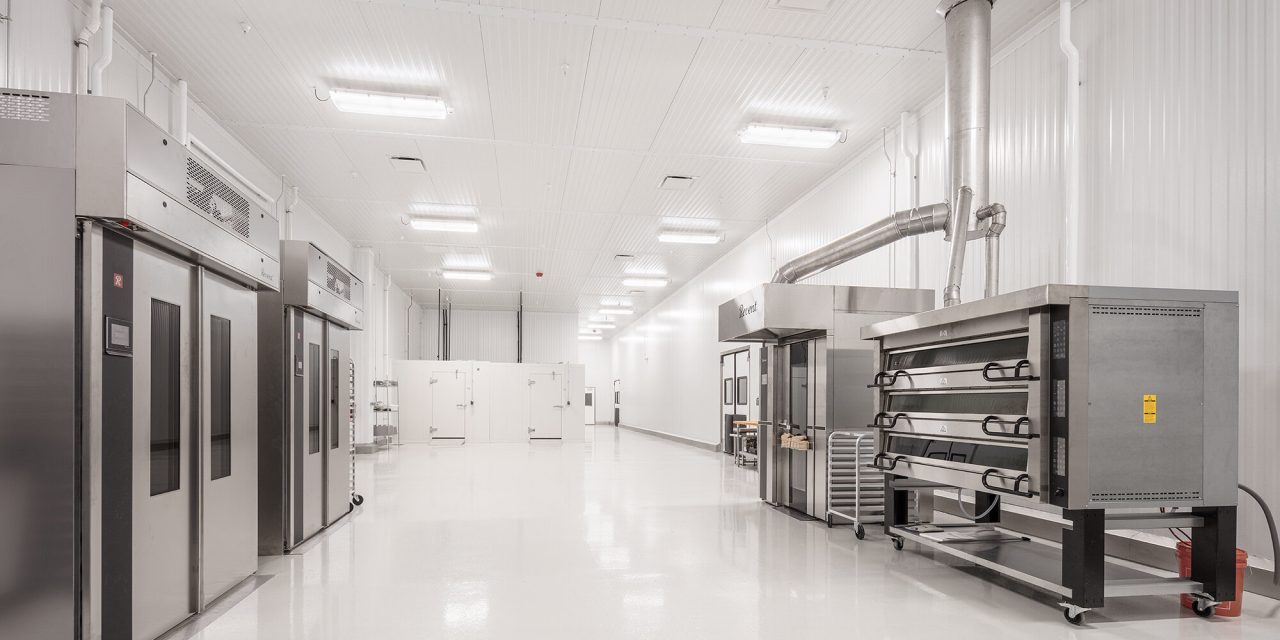
Walking through the facility, with equipment ready to be configured and tested and dedicated processing areas allowing components and parts to be changed quickly as trials evolve, that philosophy becomes tangible. Even the practical details — from controlled hygiene and PPE requirements through to the ability to source customer ingredients internationally when required — reinforce the same principle: testing is intended to remove uncertainty, not introduce another layer of it, and for a bakery considering a major investment, that distinction matters. A machine can be demonstrated almost anywhere. What is harder to replicate is the opportunity to bring your own ingredients, your own product ambitions and your own production questions into a working environment, then sit down with people who understand what happens when those ideas meet industrial reality.
That, ultimately, was what I found most interesting about being invited to see Rademaker’s Chicago Experience Centre first-hand. Beneath the engineering, automation and impressive scale of the operation is a deliberately measured approach to innovation — one that looks forward without being too quick to abandon what has already been learned.
That is perhaps the most revealing thing about Rademaker after almost five decades in bakery technology: its idea of progress is not about moving faster, but knowing when, why and how to move forward.
Building the bakery around what comes next
Walking through Rademaker’s Innovation Centre in Chicago, it quickly becomes apparent that the facility is intended to demonstrate more than individual pieces of bakery equipment. The emphasis is on how technologies interact, and how the people using them can make sense of an increasingly complex production environment.
During my visit, I spoke with members of Rademaker’s team across several areas of the business, including Doug Hale, Director of Systems Integration. Doug leads a small engineering and project-management team responsible for bringing complete production systems together, from initial planning through integration and commissioning.
Our conversation offered a useful perspective on one of the less visible aspects of modern bakery automation. The machines may be the most tangible part of an installation, but making them work as one system – and ensuring the people operating that system understand it – is where much of the complexity lies.
Rademaker’s System Integration team takes responsibility for designing, integrating and commissioning complete, turn-key bakery solutions, whether a customer is expanding an existing facility or developing a new one. Its scope can encompass ingredient handling and mixing through dough make-up, proofing, baking, cooling or freezing and packaging.
The approach combines Rademaker’s sheeting technology with carefully selected Tier-1 equipment from established partners, creating a solution tailored to the customer’s product, facility and production objectives. For the customer, having a single point of responsibility can mean clearer communication, faster decisions and fewer interfaces to manage, while flexible layouts can help accommodate future changes.
But Doug’s definition of integration extends beyond the physical connection of equipment. For him, knowledge is becoming just as important.
“The baking industry as a whole hasn’t duplicated the knowledge that we had years ago,” he told me. “So there’s a big void of both system knowledge and probably product knowledge inside, whether it be commercial or even retail bakeries.”
That knowledge gap becomes increasingly significant as automation develops. Rademaker’s role can begin long before equipment arrives on site, helping customers take a product from bench scale to industrial production, plan the technology required and troubleshoot product or equipment issues.
“The need to increase the bandwidth of knowledge within an industry is desperately needed,” Doug said. “That’s a niche that companies like ours fit.”
Labour availability is one of the clearest forces driving this shift. Doug described encountering bakeries where contract labour represents around 30% of the workforce, creating a challenge beyond simply filling vacancies. “When you do contract labour, you don’t have system knowledge that stays in the building,” he explained. “It goes away every time that contract’s up, whether it be a week or a month or a year.”
Automation therefore changes the question being asked of a production line. It is no longer simply about how many workers a machine can replace, but whether an increasingly automated system can allow a bakery to continue operating effectively with a smaller workforce. “As we become more automated, it’s not now anymore about baking,” Doug said. “It’s about how do I make a system automated to replace maybe a team of people and make it more singular in nature.”
That is also changing the traditional return-on-investment calculation. “The industry is starting to recognise that it’s just not going to happen for free,” he said. “To really plan for the future and plan for a continued reduction of labour availability, they’re going to have to make that investment.” As Doug sees it, the question is becoming less about headcount savings and more fundamental. “It’s no longer about how many people am I able to replace to get my return of investment; it’s really about, can I even run the plant?”
Yet automation does not remove the human element. In fact, Doug believes one of the greatest challenges in implementing an integrated system is getting employees to take ownership of the technology. “One of the greatest challenges we have as a team is getting a facility that we just worked with to embrace the new technology that they just put in,” he said. Rademaker therefore treats implementation as an ongoing teaching process, supporting training and returning to facilities where employees need further help. Without that engagement, Doug says, workers can simply switch automation off and return to familiar processes. “Many times we find that employees will actually just shut the automation off and return to what they know is normal,” he said. “So we have to come back and reintroduce them as to why this is important.”
The skills required on the factory floor are changing too. An employee previously carrying out a repetitive manual task may now need to understand programmable logic and troubleshoot cause and effect. “I think there’s probably a pay-scale change coming,” Doug said. “It takes more skilled labour.”
That additional skill requirement, he believes, could also contribute to retention if the industry recognises and rewards the changing nature of these roles.
Integration can also provide a deeper understanding of how a production line is performing. Not every machine necessarily needs to communicate directly with another, Doug explained, but connecting systems can give operators and managers information about product and environmental temperature, electrical loads and potential mechanical problems. “Is the equipment running at the right amperage all the time?” he asked. “Or do we have a problem with a potential bearing failure coming?”
Rademaker is seeing increasing requests for systems to communicate with one another and feed information into management systems, although Doug estimates fewer than 10% of the company’s products currently require this level of connectivity. “It’s certainly a nice tool to have, but it does add cost,” he said. The value becomes clearer when data can be connected directly to financial performance. A customer who understands the impact of yield and waste can more easily see the benefit of better production information. “If you manage this system really, really well, you might be able to improve your yields by 5%,” Doug said. “They know that immediately equates.”
Overall cost and yield are therefore key drivers for integrated systems, with capacity close behind. The ability to produce more without proportionally increasing resources is particularly important when both labour and factory space are under pressure.
Space was another theme Doug returned to during our discussion. Technology is allowing bakeries to make increasingly creative use of vertical space, while newer equipment can lift and return product without requiring the same multi-level production flows traditionally used in bakeries. “We’ve got more creative on how to utilise our vertical space,” he said, noting that customers can find themselves with 30,000 square feet when they might ideally need 100,000. “Compact doesn’t necessarily mean more expensive,” he added.
Alongside these operational pressures is a changing product landscape. Doug sees a generational shift in purchasing habits, with younger consumers showing greater interest in products associated with traditional production, fewer preservatives and more natural characteristics. “We’re seeing the commercial bread aisle shrink,” he said. “And we’re seeing artisan products come alive.”
That is already reflected in Rademaker’s project work, according to Doug, with increasing activity around artisan-style products, unique products and smaller batch sizes. The trend reinforces the importance of flexibility. A bakery investing in a production system today needs to consider not only what it is producing now, but what it may need to produce in the future.
“I think we’re dealing with the issues of today and we’re not considering what the issues of tomorrow might be,” Doug said. For him, future-proofing means designing systems with enough flexibility to adapt rather than becoming fixed around a single production requirement. “Otherwise you become obsolete and you can’t respond,” he said. “So it would be a more flexible bakery with the ability to change.”
That is a question Rademaker brings into the conversation from the outset: “Here’s what you’ve asked me to do today. What’s your thoughts about tomorrow?”
The same principle applies to emerging technologies such as AI. Doug is not yet seeing AI fundamentally changing systems integration on a widespread operational level, but he believes the potential lies in equipment learning from production data.
“The future is coming where the data that I put into equipment can become teachable and learnable,” he said.
Rather than relying solely on operators to respond to changing conditions such as temperature or dough tension, he envisages equipment learning those changes and adapting on the fly.
The practical value of Rademaker’s approach became particularly clear when Doug described a customer that had initially attempted to design, purchase, implement and commission a new production line internally. As the project progressed, the demands of the installation began to affect the team’s ability to manage its day-to-day operation. Rademaker was called in to help.
“We came alongside them, which then allowed them to continue to manage their day-to-day,” Doug said.
Rademaker’s involvement also provided an advocate during commissioning and training, helping the customer achieve a startup curve that was half of what had originally been expected.
“We serve as an advocate for them, especially at ground level when you’re turning the equipment on and people are panicking because they don’t know what they’re doing,” Doug said. “We can be a calming force to just work with the employees and make it a win.”
For Doug, those early wins matter. Getting product out of the door demonstrates to employees that the system works, allowing confidence to build before production is progressively ramped up.
That emphasis on relationships was particularly striking in the context of my visit to the Innovation Centre. The facility provides a physical environment in which technologies can be explored, but Doug’s description of systems integration suggests that Rademaker sees the relationship continuing long after the equipment has been installed.
“We look at that transaction as a lifelong journey where we’re alongside that customer all the way to the end,” he said.
Perhaps the clearest indication of that philosophy comes when Rademaker returns to a customer site and the relationship has moved beyond commissioning.
“When we walk into a plant that we’ve just been in, it’s a blessing to have somebody recognise you and go, ‘Oh, I’m so glad you’re here. We have a whole bunch of questions.’” From the perspective of a visit to the Innovation Centre, it is a useful way of understanding what sits behind the machinery on display. Systems integration is not simply about connecting equipment. It is about understanding the product, the factory, the people and the pressures surrounding them – and building a production system capable of adapting as those factors change.
From equipment supplier to technical partner
During my visit, I also spoke with Nick Magistrelli, Vice President of Sales for Rademaker USA, about the thinking behind the facility and how its role has developed since opening.
For Nick, the decision to establish the centre in Chicago was part of a much longer move towards greater independence for Rademaker’s North American operation. Rademaker USA was incorporated in the US in 1984 and had moved into a larger facility in Hudson, Ohio by the late 1990s. But, as Nick explains, being thousands of miles from the company’s customer base made local capability increasingly important.
“Being 4,000-plus miles away from our customer base, it was important for them and for us to be here and be local,” he says.
The experience of Covid further highlighted the need to strengthen that local presence, particularly around service, sales and parts. Two years ago, Rademaker made the decision to expand into Chicago, while retaining its Hudson operation, placing the new facility close to O’Hare and making it easier for customers across North America to access.
That accessibility is particularly important because the centre offers something that a brochure, virtual demonstration or trade show cannot: the opportunity to bring ingredients, recipes and personnel into the facility and work directly with Rademaker’s equipment.
The centre houses two Radini production lines, one focused on artisan breads and highly hydrated doughs, and another featuring a three-section laminator with a make-up table and croissant machine. Alongside these are spiral mixers, proofers, retarders, coolers, freezers and deck ovens.
“We wanted to be able to have here the ability where, if somebody doesn’t want to make the trip to the parent company in the Netherlands, they could fly locally, bring their ingredients here and then have their personnel come here,” Nick explains.
That hands-on approach is central to the centre’s purpose. Customers can work with Rademaker’s dough technologists, test their own ingredients and see how their dough behaves on the proposed equipment. As Nick puts it, customers can “kick the tires” before committing to a major investment.
It also reflects a broader change in Rademaker’s approach. Historically, the company saw itself primarily as a bakery equipment manufacturer: provide a specification and Rademaker would build the machine. Today, the relationship is intended to be more collaborative.
The company has built up a team of dough technologists at its technology centre in the Netherlands, while developing similar capabilities in North America. Customers can therefore use the facility to test flour, ingredients and doughs against the configuration of the line being considered, with the process allowing both sides to make adjustments before a system is built.
“We make a lot of pivots around here,” Nick says. “They’ll have something already here where they think this is what they’re going to do. They come in here and we work together and, in the end, it comes out and we’ll figure out, ‘Let’s tweak this and tweak that.’”
For customers, that can reduce the risk associated with a major capital investment. Equipment can take months, sometimes up to a year, to build, ship and install. Discovering at that stage that the solution does not perform as expected can have consequences not only for budgets, but for production schedules and customer commitments.
Nick sees the Experience Centre as a way of mitigating that risk before it reaches the factory floor. “Anytime you’re dealing with large capital expenditures, there’s risk involved,” he says. “But a lot of times what you see is even more so is the impact on timing.” That long-term perspective extends beyond the initial purchase. Nick points to customers who have continued working with Rademaker for decades, with some now operating their third, fourth, fifth or even sixth production line. “When you operate with the mentality that you’re going to build long-term relationships and partnerships, you’ve got to do things right,” he says.
It is an approach that also feeds into the industry’s changing workforce. Like Doug, Nick sees staffing as one of the major challenges facing North American bakeries, with automation increasingly providing an opportunity to support existing employees rather than simply replace them. “The labour shortage is an issue in North America for all things that we’ve talked about today,” he says. With Rademaker’s systems integration capability, customers can now look beyond sheeting and make-up equipment and source wider bakery systems, from mixers and silos through to proofers, ovens and robotics.
What stays with me from the visit is a company that understands progress is as much about listening, testing and learning as it is about the technology itself.