Raw material prices are rising, supply chains are faltering and the effects of Trump tariffs are still being felt – the baked goods industry is facing major challenges. How are inflation and trade barriers affecting prices, production and competitiveness?
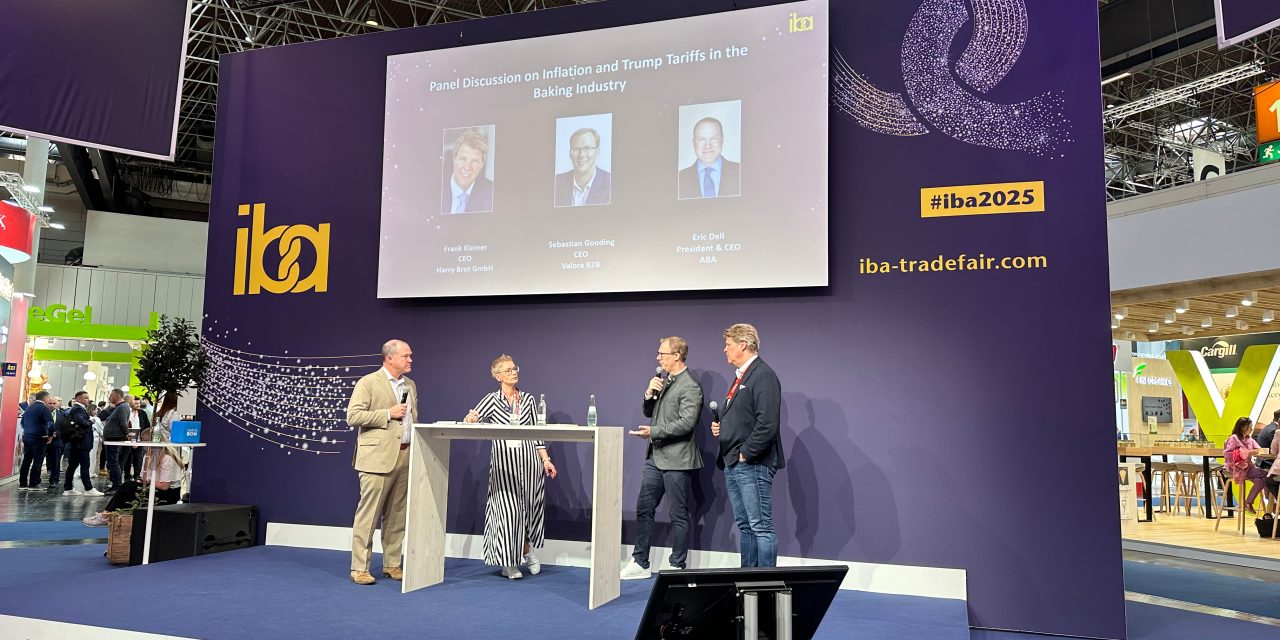
In a candid and wide-ranging keynote panel at iba 2025, top leaders from the baking industry tackled the pressing challenges posed by inflation and trade tariffs; topics that have dominated boardroom conversations from Hamburg to Washington, D.C.
The discussion, titled “Inflation and Trump Tariffs in the Baking Industry”, brought together Frank Kleiner, CEO of Germany’s Harry-Brot GmbH; Sebastian Gooding, CEO of Ditsch; and Eric Dell, President and CEO of the American Bakers Association (ABA). The conversation offered transatlantic perspectives on navigating a turbulent economic and political environment. Kennedy’s Bakery Production’s Editor, Kiran Grewal, reports live from iba 2025.
“Inflation is a big topic for us”
Frank Kleiner opened the dialogue by offering a German perspective. “Inflation is a big topic for us,” he said, citing the aftershocks of the Russia-Ukraine war. “Gas is most important for baking, and we know where it came from. At the same time, wheat prices surged.” Though some costs have stabilised, the underlying tension remains. “Wages have risen more than the inflation rate. The market is aggressive—there is no growth.”
Sebastian Gooding of Ditsch, a major pretzel producer with operations in Germany and the U.S., echoed Kleiner’s concerns but emphasised adaptability. “We’re on a journey to renormalising—but the world changed again,” he said. “We’re in an extended period of volatility.” Gooding described a significant shift within his organisation, from volume-driven efficiency to radical portfolio and process reassessment. “I know now more about costs in my business than I ever did. We’ve had to become more analytical and decisive.”
American consumers under pressure, but still indulging
Eric Dell brought a broader industry-wide and political lens from the U.S., where the ABA represents the full spectrum of the baking supply chain—from millers to equipment manufacturers. He pointed to a sobering statistic: “94% of American consumers are concerned about inflation and prices.” Though dollar sales are up, volume is down, indicating a cautious consumer base.
Still, there is resilience. “Even though they’re concerned, consumers still say, ‘We want that sweet good, we want that treat,’” Dell said. “I was surprised by how positive bakers were at our recent convention. They said, ‘We’ve been through worse. We’ll get through this.’”
Tariffs: A political wildcard
The discussion naturally turned to the return of Trump-era trade tariffs, recently reintroduced under the current U.S. administration. “The president likes tariffs—it’s part of his belief system,” Dell remarked. “It creates uncertainty, and you can’t run a business on uncertainty.”
The ABA has been actively lobbying in Washington. “We have staff and outside lobbyists working on this daily,” Dell said, adding that education is key. “We’re making sure lawmakers understand the real-world impact of tariffs on our industry.”
“I know now more about costs in my business than I ever did. We’ve had to become more analytical and decisive.”
Sebastian Gooding, CEO OF Ditsch
Consumer behavior: Complex and contradictory
All three panelists highlighted a paradox in consumer spending. As inflation bites, shoppers are becoming more price-sensitive, but not always in predictable ways.
“Premium brands are doing well,” Dell noted. “At the same time, private label and value brands are seeing growth. It’s not just about price—it’s about value.”
Kleiner added that even in a discount-driven German market, consumers are still buying “cake and other treats not on their shopping list. It shows they have money, but they’re cautious.”
Gooding framed it as a new kind of consumer consciousness: “The conversation is no longer just retail vs. discount—it’s lifestyle. People want value, which doesn’t always mean cheap. It might mean quality, ethics, or experience.”
Looking ahead: A cautious optimism
As the panel wound down, the mood remained positive, despite the looming uncertainty. “If I was going to be anywhere to go through a crisis, I’d be in the baking industry,” said Gooding, drawing applause from the audience. “There’s so much innovation, energy, and resilience.”
Kleiner agreed: “Germany has a new government. The economy has challenges, but we’re strong. We will find a way.”
Dell, too, struck a hopeful tone. “We just need some certainty. Even if we don’t agree with the policies, having consistency allows us to plan and grow. And in every challenge, there’s an opportunity.”
The panel closed with mutual acknowledgments and a reaffirmation of the baking industry’s enduring spirit. As Kleiner put it, “We employ hundreds of thousands of people, support millions more, and feed the world. We’ll keep investing, innovating, and moving forward.”
At a time when global politics and economics seem anything but predictable, the baking industry may well offer a model of how to rise—like dough—under pressure.
Editorial contact:
Editor: Kiran Grewal kgrewal@kennedys.co.uk